Shelf Life: What a Café’s Take-Home Larder Really Tells You

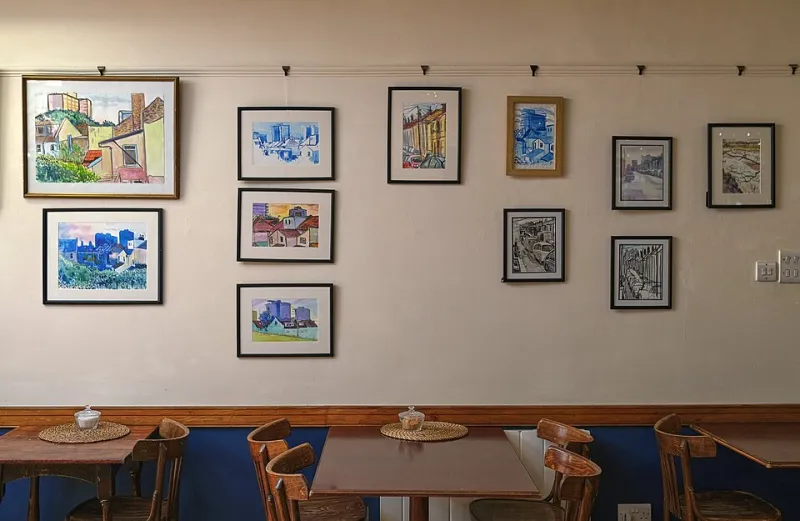
Photo: Gerald England , CC BY-SA 2.0, via Wikimedia Commons
On a grey Saturday in Bristol, the queue at Marrow & Rye is not for brunch. It is for the shelf by the till: quince membrillo in squat glass jars, cider vinegar with a handwritten batch label, a small run of smoked tomato ketchup that has already been mentioned twice on the café’s chalkboard. The room smells of toast and coffee, but the real business of the morning is happening in six rows of preserves.
This is the café larder, and it has become something more than retail. For a growing number of UK cafés, the take-home shelf is a second kitchen: a place where kitchen gluts become chutney, where the last of the autumn fruit becomes jam, and where a regular can take a little of the week home. As the 2026 gifting season approaches, that shelf is also being repositioned as a quiet alternative to the mass-market hamper—smaller, local and a good deal more personal.
The shelf as a second kitchen
A genuinely seasonal larder is not a merchandising exercise. It is a way of cooking that continues past the plate. Cafés already work with short runs, odd quantities and produce that arrives when it arrives. The larder gives those ingredients a second life: a crate of damsons becomes jam, a glut of tomatoes becomes passata, the trim from a week of lunch service becomes stock or sauce.
‘A larder should taste like the week we have had, not like a label designer’s mood board,’ says Nell Hart, who runs Marrow & Rye in Bristol. ‘If the quince is good, we make membrillo. If it is not, we do not. The shelf has to be honest, or it is just clutter.’
That honesty is easier to spot than it sounds. It shows up in batch sizes, in rotation, in whether staff can tell you what is in the jar and why it was made. It also shows up in the relationship between the menu and the shelf. A café that serves a dish with black garlic butter should be able to explain the jar of black garlic butter next to the till. A café that sells a generic ‘house chutney’ all year round may be selling a branded afterthought.
Six cafés with a larder worth lingering over
Marrow & Rye, Bristol. Nell Hart’s shelf leans on fruit and vinegar: quince membrillo, apple cider vinegar, smoked tomato ketchup. The range changes with the week, and the jars are filled in small batches. ‘We would rather sell out than stretch a batch,’ Hart says. ‘A short shelf life is a feature, not a flaw.’
The Salt House Pantry, Margate. Ferments dominate here: fennel kraut, seaweed hot sauce, a rotating vegetable kimchi. Owner Ivo Bell says the larder began as a way to use up surplus from the café’s seasonal lunches. ‘We wanted the shelf to taste of the same kitchen, not a different business,’ he says. ‘If it is not good enough for the plate, it does not go in the jar.’
Hearth & Hawthorn, Hebden Bridge. This small café’s larder is built around breakfast and baking: oat and hazelnut granola, rosehip syrup, damson jam. Owner Priya Shah describes the range as ‘a pantry for the kind of morning we serve here—slow, warm and a bit messy.’ The granola is baked in the café’s oven and bagged in compostable paper.
Fen & Furrow, Norwich. A good example of a larder that follows the growing season. In late 2026 the shelf is heavy on tomato passata, green tomato chutney and a barley granola. Owner Ruth Ellery says the café plans the menu and the larder together. ‘We do not decide in July what we will sell in November,’ she says. ‘We decide what the fields are giving us and work backwards.’
Cwmdu Larder, Brecon Beacons. Welsh honey, damson cheese and a laverbread butter sit alongside preserves made with fruit from local gardens. Owner Gareth Rees says the larder has become a neighbourhood calling card. ‘People come in for lunch and leave with a jar for their neighbour,’ he says. ‘That is the whole point.’
Paperbark Café, Belfast. Fermented chilli sauce, porter mustard and an oat granola make up a compact but distinctive range. Owner Aoife Byrne says the café keeps the shelf small on purpose. ‘Six things we can stand behind is better than twenty things we cannot,’ she says. ‘Regulars notice when something disappears. That is a conversation.’
How to spot a thoughtful larder
The difference between a considered take-home range and a branded afterthought is rarely about the label. It is about the questions the shelf can answer.
- Provenance: Can staff tell you where the fruit, honey or vegetables came from? A thoughtful larder usually has a short, specific answer.
- Batch dates: Look for made-on or batch dates that make sense. Seasonal preserves should not pretend to be permanent.
- Rotation: A good shelf changes. If the same twelve jars have been there since spring, ask why.
- Menu connection: The larder should feel like an extension of the kitchen, not a separate retail idea bolted on at the till.
- Small runs: Limited quantities are not a marketing trick when they reflect real cooking. They are a sign that the café is making rather than white-labelling.
- Staff knowledge: If nobody behind the counter can explain what is in the jar, that is a signal.
A branded afterthought tends to look the same everywhere: identical jars, generic names, no provenance, no rotation and a thick layer of dust. A thoughtful larder may be imperfect—labels slightly crooked, batches uneven—but it will feel connected to the room you are standing in.
Small jars, local gifts
With the 2026 gifting season approaching, café larders are making a quiet play for the Christmas shopper. Instead of a mass-market hamper, a café can offer a three-jar box, a granola and coffee bundle, or a single jar with a handwritten note. It is a small, local alternative to the usual corporate gift, and it keeps money in the neighbourhood.
For readers, the practical move is simple: ask what is in season, buy the smallest jar first, and check whether the café runs a return-jar scheme. A good larder is not about volume. It is about a shelf that tastes like somewhere, and a kitchen that has not stopped cooking when the plates are cleared.
That is the real test. Not whether the jar looks good on a shelf, but whether it makes you want to go back to the table it came from.